Visualisation guide
Version: 0.9.8.1
Overview
Section titled “Overview”The library generates visualisations to help interpret analysis results, particularly for impact analysis and change point detection. This guide explains how to read and interpret plot types, including correlation risk context when CPC and CTR move inversely.
Individual metric analysis plots
Section titled “Individual metric analysis plots”Generates enhanced two-panel plots for each metric (CPC or CTR) with detailed analytical overlays.
CTR analysis example
Section titled “CTR analysis example”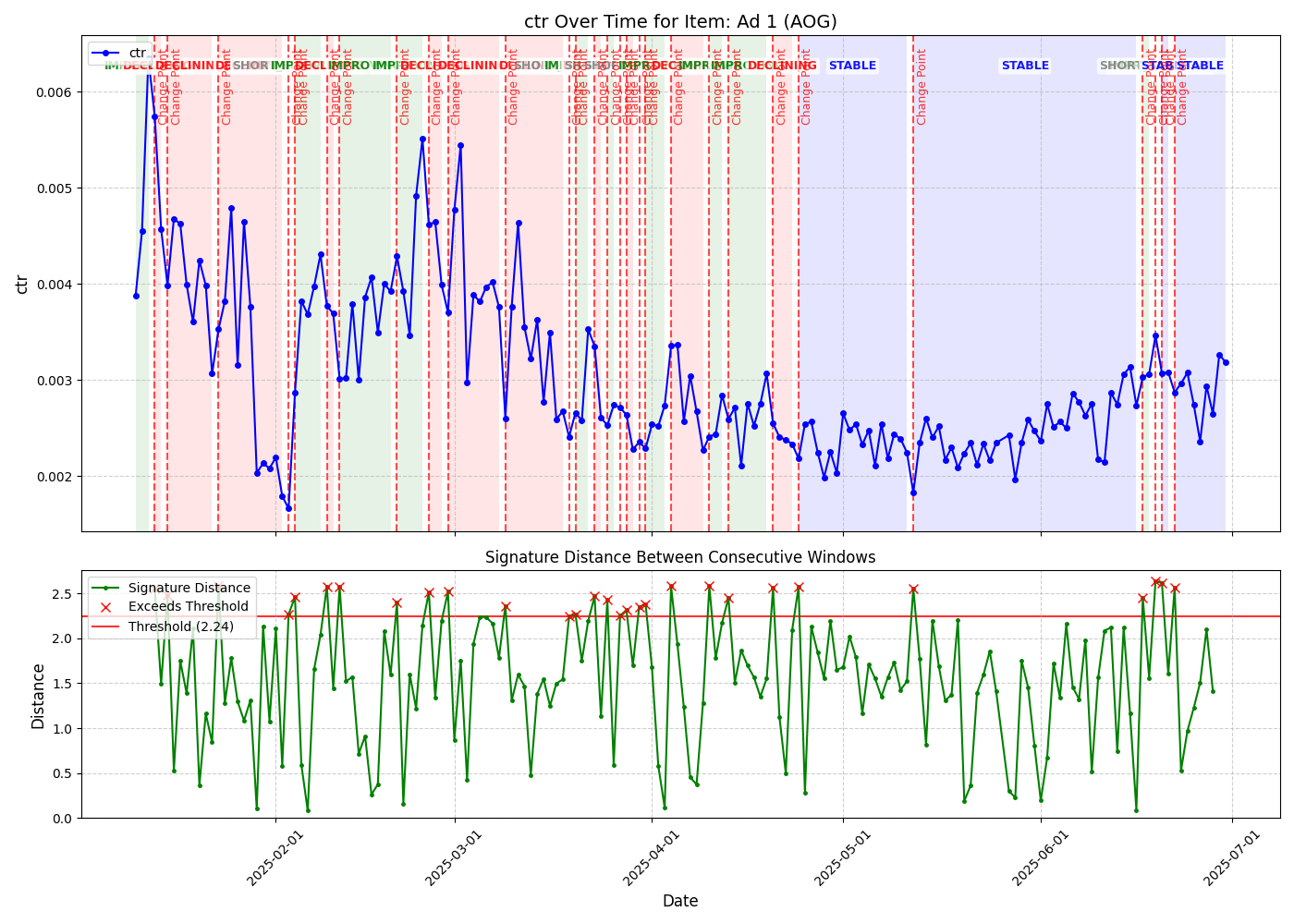
Top panel: time series with impact context
Section titled “Top panel: time series with impact context”Displays primary metric over time with key analytical overlays:
Time series line (blue)
Section titled “Time series line (blue)”- Shows actual metric values over analysis period
- Connected points indicate daily performance measurements
- Fluctuations reveal natural variation and trend changes
Benchmark line (green dashed)
Section titled “Benchmark line (green dashed)”- Horizontal line representing calculated benchmark value
- Derived from period of optimal stable performance
- Serves as reference point for impact calculations
Benchmark period highlighting (light blue shaded area)
Section titled “Benchmark period highlighting (light blue shaded area)”- Indicates time period used to establish benchmark
- Typically represents longest stable or improving performance segment
- Provides visual context for benchmark derivation
Segment trend labels
Section titled “Segment trend labels”- Text annotations showing identified trend classifications
- “STABLE” indicates periods of consistent performance
- “DECLINING” marks periods where performance deteriorates
- “IMPROVING” shows periods of performance enhancement
- Based on signature-based change point detection
Underperformance areas (red shaded regions)
Section titled “Underperformance areas (red shaded regions)”- Highlight periods where actual performance falls below benchmark
- Only shown for declining periods after benchmark period ends
- Area size reflects magnitude of impact (e.g., engagement gap)
- Vertical red lines mark boundaries of impact periods
Change points (red vertical lines)
Section titled “Change points (red vertical lines)”- Mark significant pattern changes detected by signature analysis
- Indicate transitions between different performance phases
- Based on mathematical signature distance calculations
Bottom panel: signature distance analysis
Section titled “Bottom panel: signature distance analysis”Shows sophisticated mathematical analysis underlying change point detection:
Signature distance line (green with dots)
Section titled “Signature distance line (green with dots)”- Each point represents mathematical “distance” between consecutive time windows
- Higher values indicate greater changes in underlying pattern
- Based on rough path theory and signature calculations
- Provides quantitative measure of pattern evolution
Detection threshold (red horizontal line)
Section titled “Detection threshold (red horizontal line)”- Threshold value for anomaly detection
- When signature distances exceed this threshold, significant changes are flagged
- Automatically calculated based on data characteristics and statistical properties
Anomaly markers (red X)
Section titled “Anomaly markers (red X)”- Mark time points where signature distances exceeded threshold
- Correspond to change points shown in top panel
- Indicate statistically significant pattern shifts
- Enable precise timing of performance transitions
Impact analysis dashboard
Section titled “Impact analysis dashboard”For detailed analysis, generates a four-panel dashboard summarising impact with separate operational (clicks) and financial (GBP) indicators.
Impact analysis example
Section titled “Impact analysis example”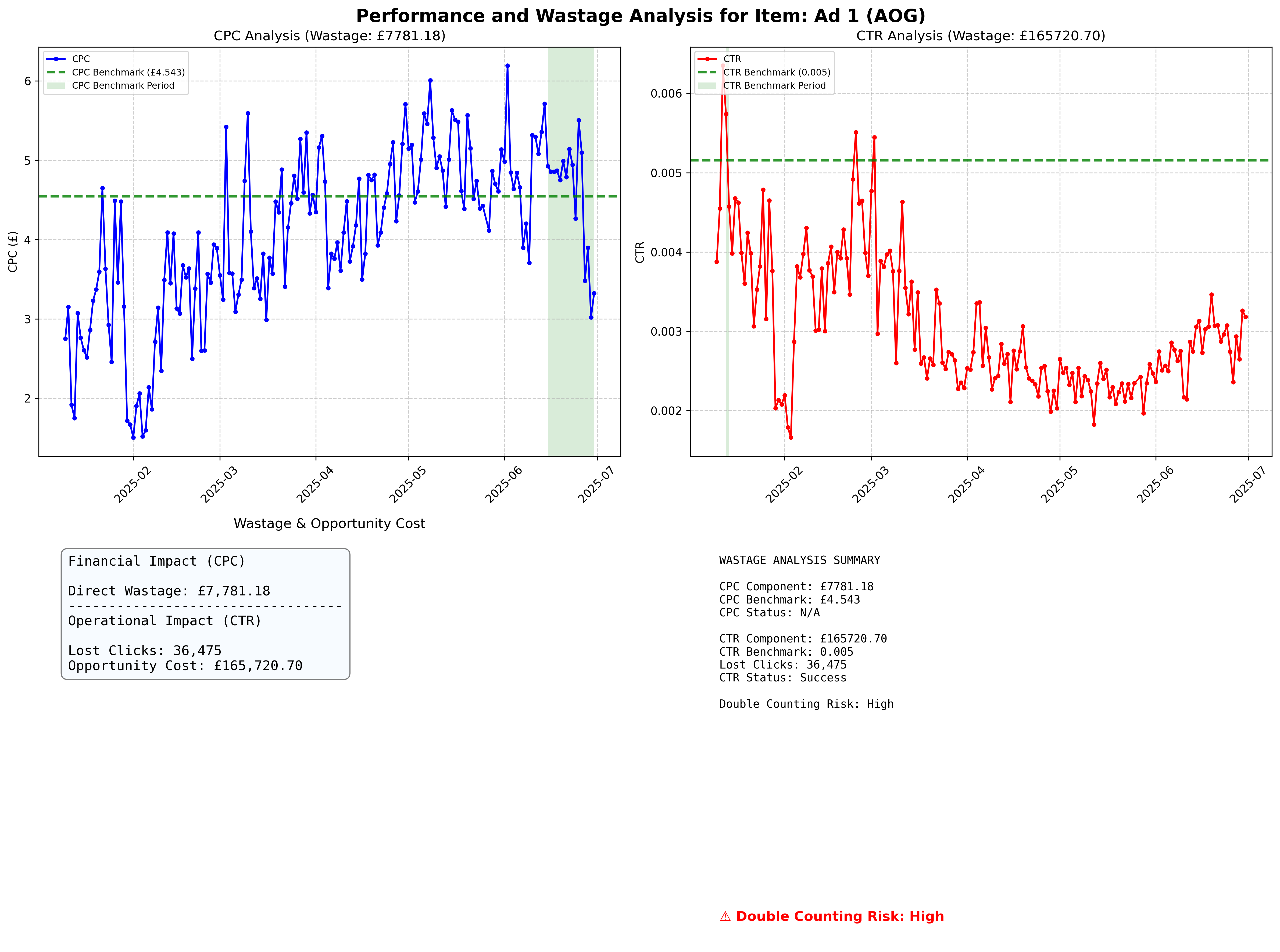
Panel 1: CPC analysis (top left)
Section titled “Panel 1: CPC analysis (top left)”Mirrors individual CPC analysis with:
- CPC time series with benchmark line and impact highlighting
- Segment trend classifications
- Change point markers
- Underperformance area visualisation
Panel 2: CTR analysis (top right)
Section titled “Panel 2: CTR analysis (top right)”Mirrors individual CTR analysis with:
- CTR time series with benchmark line and impact highlighting
- Segment trend classifications
- Change point markers
- Underperformance area visualisation
Panel 3: impact indicators (bottom left)
Section titled “Panel 3: impact indicators (bottom left)”Primary and reference indicators
Section titled “Primary and reference indicators”engagement_gap_clicks(primary): Lost clicks relative to benchmark (operational)actual_overspend_gbp(secondary): Actual overspend relative to benchmark (financial)- Do not add or combine these metrics; they are conceptually distinct
Panel 4: summary and risk assessment (bottom right)
Section titled “Panel 4: summary and risk assessment (bottom right)”Detailed text summary including
Section titled “Detailed text summary including”Impact metrics
engagement_gap_clicks(primary)actual_overspend_gbp(secondary, clearly labelled as reference value)- Lost clicks due to CTR underperformance (as engagement gap)
- Absolute and relative impact measurements (reported separately)
Benchmark information
- CPC and CTR benchmark values with calculation periods
- Provides context for impact calculations
- Shows the performance standards used for comparison
Calculation status
- Indicates whether impact calculations were successful
- “Success” confirms reliable benchmark establishment
- “Insufficient Data” or “No Declining Periods” indicate limitations
- Helps assess reliability of results
Analysis coverage and exclusions
- Analysis Coverage %: proportion of creatives successfully analysed
- Exclusions Summary: reasons and counts for excluded creatives
Correlation risk indicator
- Colour-coded severity levels when CPC and CTR move in opposite directions:
- Low Risk (Green): weak or positive correlation
- Medium Risk (Orange): moderate negative correlation
- High Risk (Red): strong negative correlation
- Unknown Risk (Grey): insufficient data for correlation analysis
- Metrics are not combined; interpret
engagement_gap_clicksandactual_overspend_gbpseparately regardless of risk level
Interpretation guidelines
Section titled “Interpretation guidelines”Understanding impact magnitude
Section titled “Understanding impact magnitude”Significant impact indicators
Section titled “Significant impact indicators”- Large red shaded areas in time series plots
- Substantial gaps between actual performance and benchmark lines
- High
engagement_gap_clicksand/or notableactual_overspend_gbpmagnitudes - Extended periods of declining performance
Minimal impact indicators
Section titled “Minimal impact indicators”- Small or absent red shaded areas
- Performance lines close to benchmark levels
- Low
engagement_gap_clicksand minimalactual_overspend_gbpin summary panel - Brief or infrequent declining periods
Correlation risk considerations
Section titled “Correlation risk considerations”High risk scenarios
Section titled “High risk scenarios”- Strong negative correlation between CPC and CTR (r < -0.7)
- When CTR declines, CPC often increases proportionally
- Do not compute any combined total; interpret each metric separately
Low risk scenarios
Section titled “Low risk scenarios”- Weak or positive correlation between CPC and CTR (r > -0.3)
- Independent variation in both metrics
- Use
engagement_gap_clicksandactual_overspend_gbpindependently; do not add
Reading signature distance patterns
Section titled “Reading signature distance patterns”Normal variation
Section titled “Normal variation”- Signature distances fluctuating below the threshold
- Indicates natural performance variation without significant pattern changes
- Suggests stable underlying performance dynamics
Pattern changes
Section titled “Pattern changes”- Signature distances exceeding the threshold
- Indicates fundamental shifts in performance patterns
- May correspond to external factors or creative fatigue
- Requires investigation and potential intervention
Trend transitions
Section titled “Trend transitions”- Clusters of high signature distances
- Suggests periods of instability or transition
- May indicate gradual performance degradation
- Useful for predicting future performance issues
Actionable insights
Section titled “Actionable insights”Performance optimisation
Section titled “Performance optimisation”- Focus intervention efforts on periods with large underperformance areas
- Address the metric contributing most to operational or financial impact
- Consider creative refresh at detected change points
- Use signature distance trends for proactive management
Budget planning
Section titled “Budget planning”- Use
actual_overspend_gbpfor financial inefficiency assessment - Use
engagement_gap_clicksfor operational impact assessment - Do not compute or use any combined total
- Plan intervention timing based on trend segment analysis
- Allocate resources based on the magnitude and persistence of each metric separately
Campaign management
Section titled “Campaign management”- Monitor signature distances for early warning of performance changes
- Set alerts when distances approach detection thresholds
- Use benchmark periods as performance targets for optimisation
- Implement automated responses to significant pattern changes
Strategic decision making
Section titled “Strategic decision making”- Evaluate creative lifecycle based on
engagement_gap_clicksandactual_overspend_gbppatterns - Compare performance across different creative assets
- Identify optimal refresh timing to minimise impact
- Assess ROI of performance optimisation interventions
Technical considerations
Section titled “Technical considerations”Data quality requirements
Section titled “Data quality requirements”- Sufficient data points for reliable signature calculation
- Consistent measurement methodology across time periods
- Adequate baseline period for benchmark establishment
- Regular data collection without significant gaps
Statistical limitations
Section titled “Statistical limitations”- Signature analysis requires minimum window sizes
- Benchmark calculations need stable performance periods
- Correlation analysis requires sufficient data points
- Risk assessments depend on data quality and completeness
Interpretation caveats
Section titled “Interpretation caveats”- External factors may influence performance patterns
- Seasonal effects should be considered in analysis
- Market conditions may affect benchmark relevance
- Multiple testing considerations for change point detection
This visualisation guide provides the foundation for understanding and interpreting CreativeDynamics analysis results, enabling data-driven decision-making in performance marketing contexts.